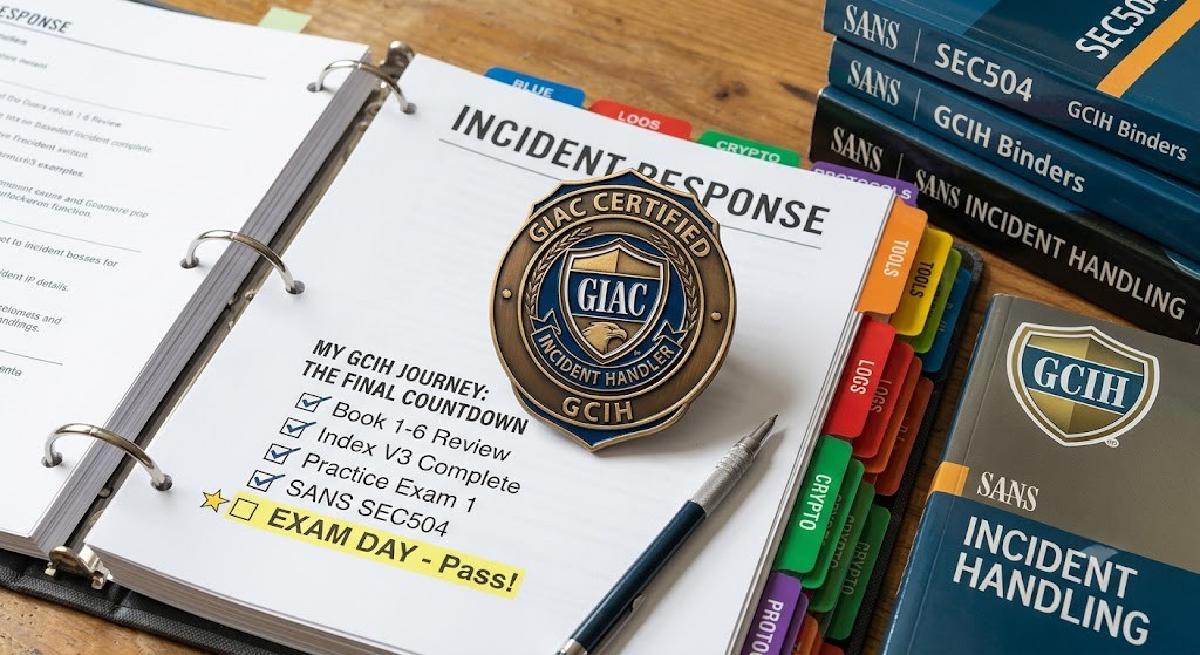
TL;DR
- The SANS GCIH (SEC504) covers incident response, hacker techniques, exploits, and live forensics.
- Preparation requires an in-depth index, hands-on workbook auditing, and strategic practice test timing.
- Passed at 90%+ score as part of the SANS Technology Institute Master’s Degree program.
Passing the SANS GCIH (SEC504) exam was one of the most challenging yet rewarding experiences in my cybersecurity journey. As part of my master’s degree program at SANS, I tackled this comprehensive incident handling certification.
Here is my complete preparation strategy, indexing workflow, and exam day retrospective.
Why GCIH (SEC504)?#
The GCIH (GIAC Certified Incident Handler) certification is a core milestone in SANS’ Master’s Degree Program. The SEC504 course (Hacker Techniques, Exploits & Incident Handling) provides hands-on proficiency in detecting, responding to, and mitigating security incidents across enterprise environments.
Key Domains Covered:#
- Incident Handling & Response Procedures: PICERL framework (Preparation, Identification, Containment, Eradication, Recovery, Lessons Learned)
- Computer & Network Vulnerabilities: Password attacks, web application exploits, session hijacking
- Live System Forensics: Memory analysis, persistence detection, log analysis with PowerShell & Linux CLI
Course Materials & Preparation Strategy#
I opted for the OnDemand course format, allowing flexible video playback and lab repetitions. The course package included:
- 5 Main Course Textbooks: Comprehensive technical theory and command references.
- Lab Workbooks & Virtual Machines: Hands-on exercises covering Wireshark, Volatility, Metasploit, and PowerShell forensic scripts.
- 2 Practice Exams: Official GIAC practice tests simulating actual exam timing and questions.
The Indexing Strategy#
Building a custom Google Sheets index was the single most important preparation activity.
My Index Schema:#
| Column | Purpose |
|---|---|
| Keyword | Tool name, attack technique, or protocol |
| Book / Page | Book number and exact page reference (e.g. B2 P145) |
| Description | Concise summary of the concept |
| Command / Syntax | Exact command line syntax and flags |
Full Strategy here: How to Build a GIAC Index That Actually Works
Exam Day Retrospective & Key Takeaways#
- Time Management: Keep moving. Don’t spend more than 2 minutes on a multiple-choice question before flagging or looking up in your index.
- Lab Questions First Pass: Perform lab questions carefully; they carry significant score weight.
- Index Trust: Trust your index lookup over browsing books randomly during the exam session.
Wrapping Up#
| Milestone / Strategy | Description | Key Action |
|---|---|---|
| SEC504 OnDemand | 6-section course video & lab training | Complete all labs twice |
| Google Sheets Index | Alphabetized term & syntax reference | Print double-sided & tab |
| Practice Test 1 | Initial test run with index | Identify missing keywords |
| Practice Test 2 | Final timed dry-run | Finalize physical index binding |